Tinyverse
Helping autistic students see themselves in the stories they read at school, one personalized social story at a time.
WORKFLOW SHIFT
NORTHSHORE PILOT
WITH A REAL TEAM
SHIPPED OR IN BUILD
Start with Social Stories.
Social Stories is an evidence-based practice developed by researcher Carol Gray, with decades of research behind it. The framework has its own opinions about how sentences should be written and which words should be chosen, but the rule that drives the actual outcome is simpler. The story has to be illustrated. And the story has to feel like it is about this child, not a child.
The people who use these stories are not only therapists. They are BCBAs (Board Certified Behavior Analysts, the licensed clinicians who design behavioral interventions), RBTs (Registered Behavior Technicians, the day-to-day support staff), teachers, and parents. The kids they serve are working on real targets: transitions during the school day, asking for help, recess, self-regulation, communication.
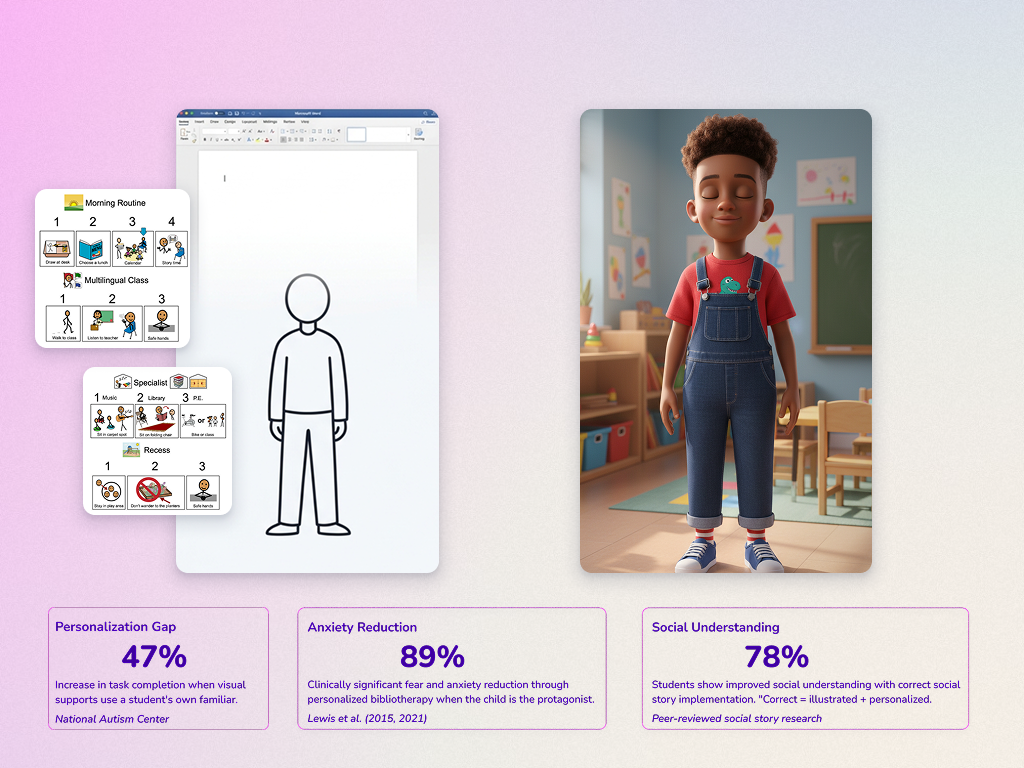
What it actually looks like in practice is the picture below. Stick figures, clip art from Google Images, hand-drawn pages stitched together in PowerPoint. The framework asks for a personalized story. The toolchain produces this.
Forty-five minutes of clip art. Two minutes with Tinyverse.
On the left, what exists today. A Word document, a snipping tool, clip art borrowed from the web, stick figures hand-arranged into a story the kid is supposed to find themselves in. Forty-five minutes of work, and the protagonist is generic. On the right, the same story made with Tinyverse. The child is the illustrated protagonist, the classroom looks like theirs, and the forty-five minutes drops to under two.
My niece deserved to see herself in the story.
The thing that started Tinyverse was watching this happen for my niece. She is autistic. She is South Asian. Every therapeutic resource her parents and her clinical team brought home was illustrated with white kids, generic clip art, or stock photos that looked nothing like her or her family.
The clinicians I watched were doing it the only way available. Google Images, snipping tool, PowerPoint, Simple Sticks. Forty-five minutes per story. The output still didn't look like the kid. The framework was being violated by the toolchain.
That moment, sitting next to my niece looking at clip art that did not look like her, was where Tinyverse started.
The research is settled. The implementation is broken.
The most important rule of the framework is the one most often skipped. The story has to be illustrated and personalized to the child. National Autism Center research shows a 47% lift in target behavior task completion when the visual support is individualized. Kucirkova's work shows 40% better comprehension when the child is the protagonist, rather than a stand-in.
But personalization takes 45 minutes a story. So clinicians settle. Schools settle. Time pressure shows up in a different way for each, and the result is the same. The personalization, the part that does the actual work, is the part that gets dropped.
That gap was what I wanted to close.
Encode the framework. Cast the kid as the protagonist.
I was close to the problem. My years as a filmmaker and storyteller gave me craft to lean on. AI tools collapsed the dependencies that would have slowed a solo build.
Three filmmaking moves shaped Tinyverse.
Cast the protagonist before writing the script. In therapy materials, the child should always be the protagonist, and they almost never are. Tinyverse generates the child first, then writes around them.
Think in scenes, not chapters. A Social Story is a four-beat arc: context, perspective, strategy, celebration. That maps almost cleanly onto a short film. The four beats are enforced by the structure, not left to the writer.
Keep the character whole across pages. A child who looks like a different person on page two breaks the illusion. Visual continuity is a craft principle from animation, and it is what made the personalization hold across an entire book.
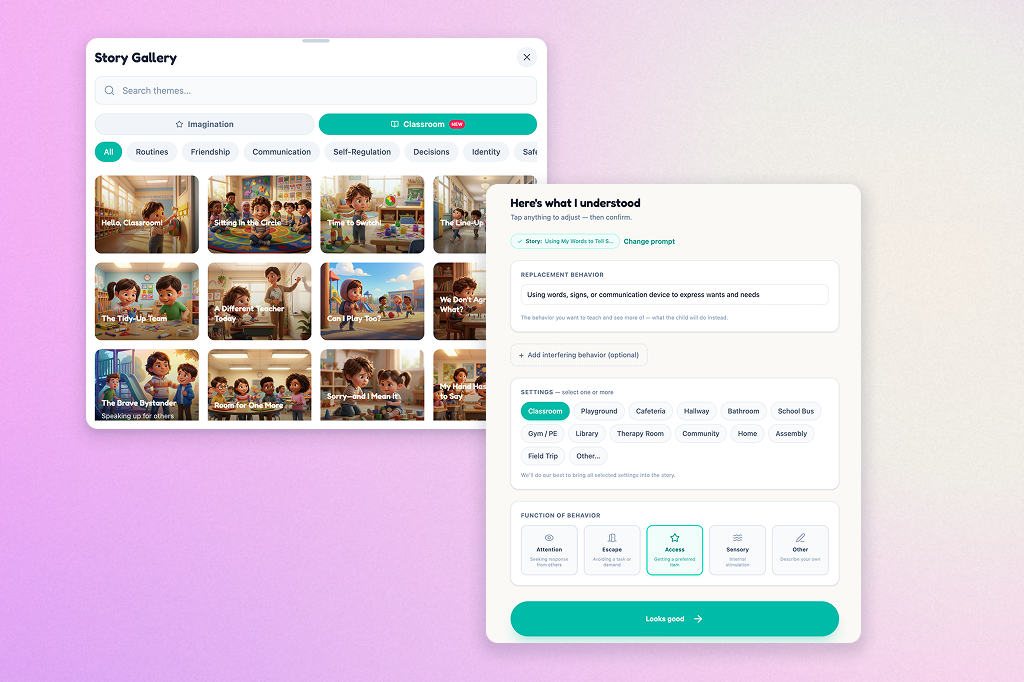
The other turn was about the interface. BCBAs, therapists, teachers, and parents are skeptical of tech that looks like a toy. They do not want to write a prompt. They are already filling in clinical fields about behavioral interventions and individual education plans every week. So the question I started with was: how much of that existing information can we translate, so the time cost of generating a personalized story drops to almost nothing?
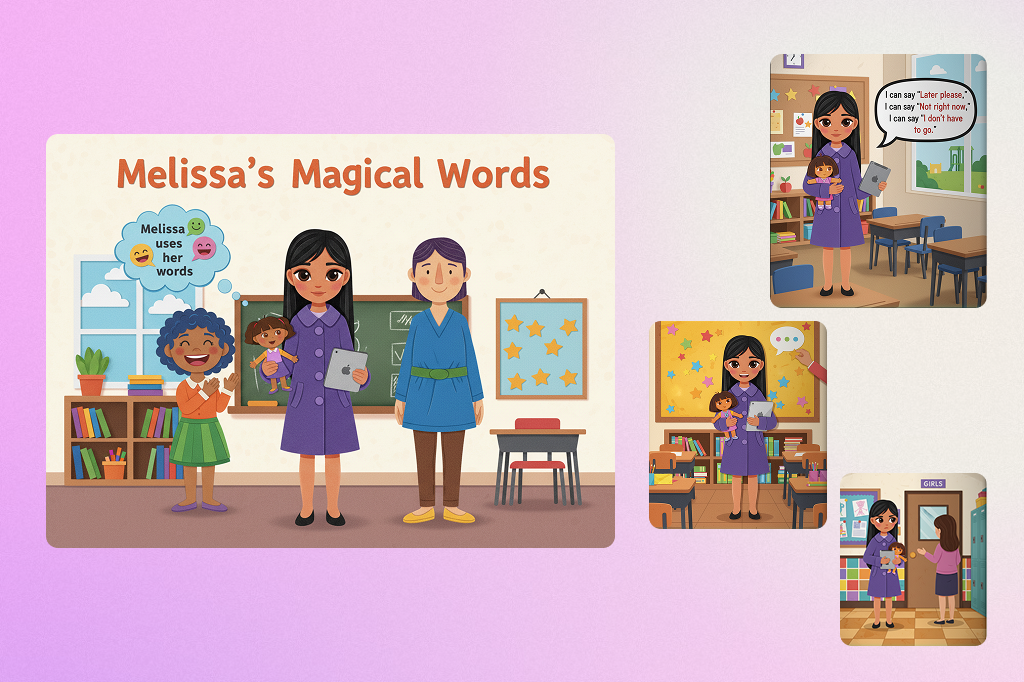
Take Melissa, for instance.
Melissa is learning to use her words. The moments when she needs to say no, when she needs more time, when she needs to step away, used to leave her without the language to respond. Tinyverse generates a story where Melissa is the protagonist. The story gives her the exact phrases, in her own voice. "Later please." "Not right now." "I don't have to go." Her face is the face on every page.
Beyond this one story, parents, teachers, and clinicians can prompt for any new situation: a first dentist visit, a flight, a new sibling, a fire drill. Hundreds of stories already live in Tinyverse, and the same character continuity holds across all of them. Melissa stays Melissa, page after page, story after story.
A Social Story is not a one-time read. It works through repetition.
One story, read once, is the start. The lift comes from the kid encountering the same idea in different shapes across the week. So the question I kept asking was: what other modes can carry the same story forward, without making the team build everything from scratch each time?
Re-engage the same characters and scenes through art, so the story enters the body through the hand.
SHIPPEDA reinforcement flyer that prints alongside the story, like a cheat sheet of the steps the kid just read about.
IN BUILDThe story's language, set to rhythm. Music carries memory in ways prose cannot.
EXPLORINGVisual matching games that pull the same characters and steps forward into another mode.
EXPLORINGThe instinct here came from years of building reinforcement into product onboarding at scale. A new behavior does not stick the first time someone sees it. The same is true for a kid learning to ask for help. The story is the beginning of the loop, not the end.
As a designer, I wanted to build everything. As the product person, I had to wait, learn, and limit.
The strangest part of being solo is the tension. As a designer and a creative, I wanted to build all of it: the songs, the schedules, the coloring books, the matching games, the video. As the product person, I had to keep the surface small, so I could actually learn from how the team was using what was already there. The hats argue with each other in a useful way.
Choosing what not to build.
No direct-to-child interface. Adults gate everything: BCBAs, teachers, parents.
Stayed inside Social Stories and bibliotherapy-arc freeform stories. No DBT, no genogram, no other interventions yet. Sharper on autistic kids first, before widening the lens.
Did not rebuild the clinical intake. BIPs and IEPs already exist. The work was, how do we take that information and pull it inside, instead of asking the team to type it again.
Thinking in systems, not features.
Tinyverse is three systems working together:
- Story generation. The Carol Gray framework, encoded into the structure.
- Visual illustration. A way to keep the same child consistent across every page of every book.
- Child profile. The interventional plan, the IEP, and what is known about the child.
The interesting design problem was getting the three to stay in sync. The story knows the child. The illustrations know the child. The profile knows the child. The hard part was the synchrony, not any single piece.
Inventing the form factor where none existed.
A supplemental clinical intervention tool, disguised as a creative tool. Purpose-built for one specific need, not a general-purpose toy. Guardrails are part of the design, not bolted on after: photos delete after generation, every story follows a therapeutic arc (Carol Gray's for Social Stories, bibliotherapy arcs for freeform), age-appropriate themes only, and the same character holds across every page.
Most AI-for-kids products are entertainment. Tinyverse is intervention. Intervention asks for different design choices. Slower. More guarded. Less novelty-seeking. The craft lives in the difference.
One person, three judgments, one product. That is the value of the loop being short. Oh boy, it is also overwhelming.
A real district. A real team. Real signal.
Tinyverse is currently in pilot in Northshore School District in Washington State, one of the largest districts in the Pacific Northwest. The pilot launched in March 2026. The team using it is not just BCBAs. It is teachers, BCBAs, and RBTs working together, which matters because Social Stories cross every part of the school day, the classroom, the recess yard, the bus, the bathroom routine.
About 20 students are reading social stories generated by Tinyverse. The pilot runs for nine weeks before school ends in June.
CONFIRMED IN WRITING
SHIPPED OR IN BUILD
REVIEW PASSED
THROUGH SCHOOL YEAR
What we are watching, lightly:
- Time saved per story. The obvious one, and the easiest to count.
- Which features get used and shared. A signal of what actually fits the team's day.
- How often each story gets re-read. The reinforcement loop showing up in the data.
- Behavioral observations from the team. Anecdotal, and the most real.
One of the team told me he prefers anecdotal effectiveness over time-on-task tracking, because that is what a real classroom feels like. So the measurement reflects what practitioners actually use. This is a real pilot, not a randomized trial. We are trying to evolve the measurement as the team works with the product.
What I chose not to build, what I almost killed, and what the team changed my mind about.
- Direct-to-child interface. Adults gate everything. The kid never sees a prompt or a setting.
- DBT or genogram interventions. Stayed in Social Stories and bibliotherapy. Sharper, narrower, more honest.
- A new clinical intake system. BIPs and IEPs already exist. We pulled in what was already there.
- Time-tracking dashboards. An RBT told me he didn't care about saved hours, only behavioral change. Moved out of the product.
- Standalone visual schedules. Initially deprioritized. The team's response brought back a lighter version, a reinforcement flyer that prints alongside the story.
- Child profiles in v1. I almost stayed away. The team came back asking for it, because it would save them more time. Now it is on the roadmap.
- First-person voice. I had third-person as the default. The team flipped me to first-person, the clinical norm.
- Shared team folders. I assumed BCBAs created stories alone. They wanted to share within minutes. Top requested feature.
- Cultural celebration themes. I almost cut the forty themes as not commercial. The team treated them as serious. I kept all of them.
What this taught me, that I will carry forward.
AI completes existing evidence-based practices more powerfully than it invents new ones. Carol Gray's framework was already settled. The toolchain was the gap. Closing the gap was a more interesting design problem than inventing a new therapy, and a more honest one in service of the kids it is built for.
Personalization is the mechanism, not the marketing. The clinical research is unambiguous: the lift comes from the child seeing themselves. Everything in Tinyverse is in service of that single mechanism, and of the community it is meant to help.
Cultural representation is design, not flavor. The forty cultural themes (Diwali, Navratri, Eid, Día de Muertos, bilingual identity) exist because systemic racism gets encoded in clinical tools when they default to white kids and stock images. That is not a marketing line. That is the actual reason. It is the most original design decision in the product, and I almost cut it.
Constraints sharpen judgment more than budgets do. Solo, with the AI agent, with a real pilot giving real signal, I made faster and better decisions than I have made on much larger budgets in much larger orgs. The constraint was the gift.
Small pilot. Long arc. Service as the through-line.
The pilot is real, and it is small. Twenty students, a multidisciplinary school team, nine weeks. Outcome measurement is still maturing. The longer arc is therapeutic content for kids in many forms, stories now, songs and visual schedules and video as each becomes possible. Not a media platform. A set of shapes that the same care can take, depending on how a kid learns best.
Tinyverse is a project I keep going on weekends. The point is to keep evolving it so schools, families, and clinicians have better tools for the kids who need them. Technology in service of those who need it most.
I am still figuring out the shape of every part of this. The right way to measure outcomes. The right time to bring in another pair of hands. The right way to honor the families and the team that have trusted Tinyverse with their kids. None of that is solved. All of it is ongoing.
My work as an enterprise AI design leader shows me leading transformation at scale.
Tinyverse shows me building from zero, with constraints clarifying judgment, in service of a community I am close to.
Both keep my craft active. Both, in different ways, serve the people the work is for.